Page 1 of 1
O.P.A.L.
Posted: 08 Oct 2019 06:38
by BlankSlate
What is the whole O.P.A.L. about?
I've seen it used a lot on these forums, but what does it stand for?
Re: O.P.A.L.
Posted: 21 Oct 2019 22:41
by O.P.A.L
Oh no im so sorry for missing this, i honestly dont have a clue how i did. O.P.A.L. is a group of people (13 right now) that all work on the many interconnetcted dots in all religions, so that we may find an answer or just find what we seek. We hang around here since Dave has worked at the mathmatical and factual connection between the dots and it helps us out a ton. As for its meaning, it has many the name was chosen by our "founder" and he has given many many meanings for it. For a quick summary you could see us as a sort of a cult i guess but we keep to ourselves and get our own answers for many things since we all believe that your own conclusion should be the only one that matters in the end.
It could help if you go to our profile and read our previous posts, and if you or any one has questions we would be grateful to answer them.(sorry for any wierd what-nots this was done on a phone)
All minds settle apart
But in the end the truth finds heart
With wits combined
And the stars aligned
We may see the truth unfold
Many years hidden beneath the cold
The shining gears now old
Just for the rust to take its hold
Re: O.P.A.L.
Posted: 26 Oct 2019 13:13
by Redbeck
Dear BlankSlate welcome to the Oracle forum community and thank you for your question. Redbeck
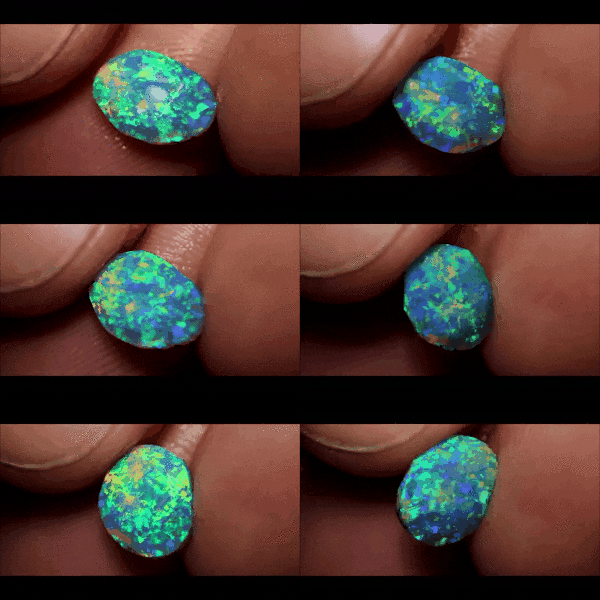
O.P.A.L. has of course responded in eloquent fashion for which I am most grateful. However, I would point out that the an Opal as a precious stone is also an apt symbol for a group of contributors. Essentially it is a mineraloid collective, made up of small spheres of silica gel,'chips' of silicon and suspended pockets of oxygen, which in terms of effect cause interference, refraction and diffraction of light, resulting in the Opal's distinctive 'play of colour'. The varying refractive indices of the spheres and spaces between them dissect light as it passes through the stone. As the light enters the opal, it bends around the tiny particles or 'spheres' of hydrated silica, as well as 'chips' of silicon and oxygen suspended within the stone. Light is therefore comprised of all visible colours and able to produce an entire spectrum of hues when it is diffracted.