Save Our Soil
Posted: 25 Aug 2015 20:20
I was recently quizzed by a female friend as to my constant use of the term beyond-organic in reference to agriculture. “Pretentious moi, mais non!”, but given the tenaciously enquiring mind of said individual, no sun would have shone on my back door that day without an essay-length explanation as opposed to a few well chosen highlights.
Indeed the question is massively important to the long term future of human kind and therefore which goes without saying to http://www.973-eht-namuh-973.com in its capacity of a vehicle for change. Without the revival of the fundamental eco-systemic substance that sustains the cultivation of planet Earth’s most nutritious foods and medicinal plants, as well as the maintenance of an eco- structure capable of sustaining long-term groundwater conservation then the battle against encroaching desertification is lost.
So what exactly is beyond-organic, a typical 21st Century agricultural tagline or one of the key components to that most serious of missions, saving the world. Well as they were want to observe in radio gardening programmes of the 1950s and 1960s, "the answer lies in the soil". And it truly does!
However, the more commonly used technical description of this crusade to save the underlying fabric of farming and market gardening at all points of the compass is Permaculture.
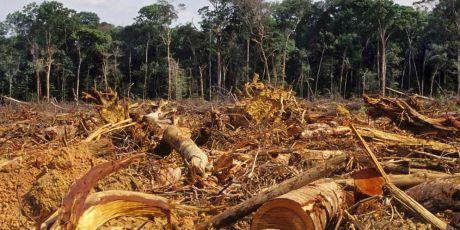
Humans have been farming organically for around11,900 years, yet that hasn’t prevented us from destroying the natural environment along the way. Losing tilled exposed topsoil year-on-year, felling great swathes of forest to make way for crop fields. Destroying the complex eco system nurtured beneath their leafy canopy and continually exposing the soil until it erodes stripping this natural growth force back to rock and clay, ultimately turning good crop bearing tracts into a barren wasteland
Organic only farming still applies a conventional agricultural model but does eliminate the use of chemical-based pesticides (widespread use post WWII onwards) and fertilisers (first introduced in the 19th Century). The process does however continue to involve ploughed fields and bare earth for a good part of the year, which still disrupts the soil’s established eco system on a seasonal basis. In effect there is a need to build a new eco-system following each growing cycle as good bacteria, beneficial micro-organisms, earthworm and other colonies are dispersed or even lost altogether. In essence organic farming is still taking more out of the soil than it puts back in although dismissing the use of chemicals that poison the above and enter the food chain.
The organic system also requires the consistent importation of large quantities animal and poultry generated faeces as manure in lieu of fertiliser along with the introduction of high nitrogen donor planting. Although both practices are common to both organic and permaculture, nitrogen planting while relatively easy in a smallholding vegetable environment is difficult to introduce effectively in wide open tilled bare earth spaces unless they are set aside purely for nitrogen induction by planting.
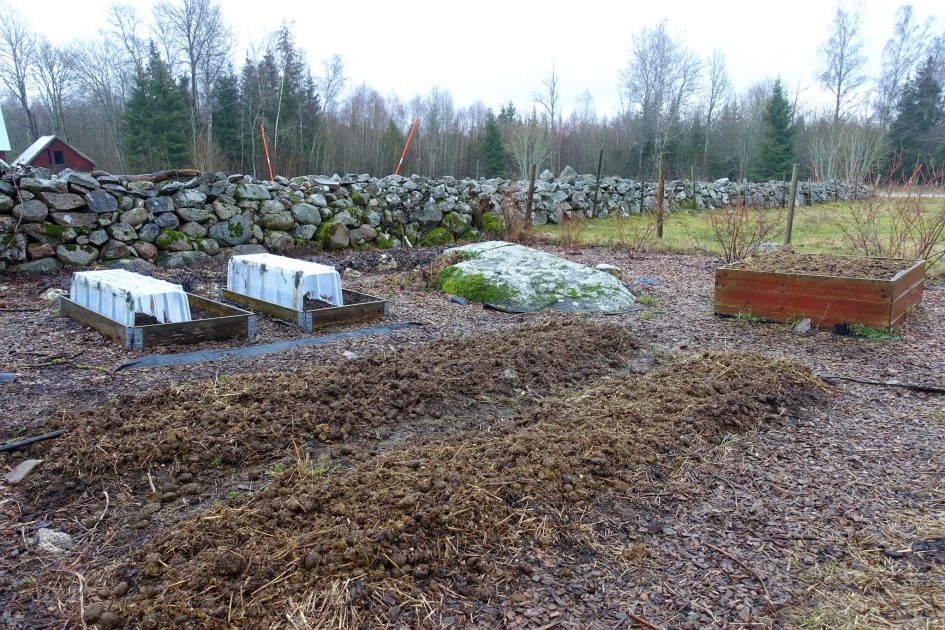
Permaculture also uses animals along with free range poultry as an integrated component of its methodology, manure is spread naturally on site and nitrogen bearing surface material trodden in. Occasionally trimmed down in the absence of livestock but without root-structure removal, natural ground cover is allowed to flourish.
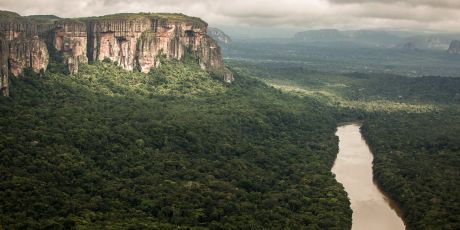
Rotationally-grazed livestock are very much part of a complete eco-inclusive permaculture process. Sheep and Hens moved around the farm are responsible for producing on site manure, treading this and other ground cover debris back into ever more fertile, yet securely root-bound topsoil. In turn better able to retain moisture but being constantly worked by foraging livestock and virtually ready to sow seed. Ecosystem built soil, for example that found in the Amazon basin or the Indonesian rain forest, has the power to retain and conserves 100 times more water than all the water bodies in the world.
As an example of the changing thought process, it was originally thought that by trampling fields or clearings Elephant herds in Africa were destroying the environment, when they were doing exactly the opposite in terms of creating a soil quality that would deliver much greater crop yields. Huge unnecessary elephant culls resulted before enlightenment prevailed. Nevertheless, graze-rotation is important as overgrazing can have the same effect as excessive-tillage in terms of desertification
Returning to nitrogen appreciation, all grass crops such as corn, sorghum, wheat, forage grasses, etc. and non-leguminous broadleaf crops for example sunflowers, potatoes, sugar beets, cotton, etc. are not colonised by nitrogen fixing bacteria and therefore must obtain the nitrogen they need from the soil. Therefore by introducing nitrogen bearing species also acting as ground cover inter mingled with crops of this type, a permanently cultured as well as cultivated, steadily deepening strata of topsoil is created held in place by root structures rather than being exposed. Especially relevant in hot climates
In essence, Permaculture seeks to build a permanent undisturbed functional ecosystem by closing the loop, in effect healing the soil. Allowing natural leaf fall as well as pruning residue to either ground compost or be converted to bio-char and return nutrients to the soil, intermingling high-nitrogen donor rooted along with pest repellent species between crop bearing plant and tree lines, application of bio-char, are all remedial actions designed to ameliorate and rebalance the eco-equilibrium of the soil.
Other integral permaculture techniques include planting high pole wood crop and bio-char material feeder trees, like Italian Alder as windbreaks to further counter top-soil erosion, they too become part of the ecosystem. High turnaround coppiced White Mulberry trees, grow quickly producing consistent bio-char feed, anchor unstable pre eco-restored topsoil and provide impressive shade in hot sun-belt climates.
Natural pest deterrents are always in use, taking an Olive farm as an example, not exactly Delia Smith but here goes, “Suspend an old plastic milk bottle punched with a few holes from an inner branch of your Olive tree, half fill with mature urine then add a fresh Sardine.” Olive flies are attracted to the combination of naturally occurring aromatherapy and protein, but do not ruin the young Olive fruit by boring into it to lay their eggs, thus diverting the nutrients bound for olive growth to support the voracious developing larvae. There are multiple recipes from all parts of the world, far too numerous to list at least in this format and many of them involve human urine, which is incidentally also high in nitrogen.
Basically beyond-organic or permaculture farming is a method devoted to restoring the soil to a cycle of natural enrichment equitable to that found on the forest floor. It is not a massively profitable profession but is among the most honourable, helping restore at least some of the resources on our planet, including the reversal of desertification, and hopefully create a better brighter future for future generations. Above all providing humankind with edible crops that are delicious, wholesome and which could be equally abundant as those produced by soil destructive chemical dependent factory agriculture. Non-carcinogenic and infinitely sustainable produce to boot, so slowly but surely more and more areas of agricultural land will come under this style of holistic management.
Were we all to help expand a permaculture farm for but a few days a year, we would undoubtedly be refurbishing our planet toward a far better physically conditioned future.
Follow the link below for a small farm that already has this land and agricultural practice refurbishment ideology firmly in action:
Indeed the question is massively important to the long term future of human kind and therefore which goes without saying to http://www.973-eht-namuh-973.com in its capacity of a vehicle for change. Without the revival of the fundamental eco-systemic substance that sustains the cultivation of planet Earth’s most nutritious foods and medicinal plants, as well as the maintenance of an eco- structure capable of sustaining long-term groundwater conservation then the battle against encroaching desertification is lost.
So what exactly is beyond-organic, a typical 21st Century agricultural tagline or one of the key components to that most serious of missions, saving the world. Well as they were want to observe in radio gardening programmes of the 1950s and 1960s, "the answer lies in the soil". And it truly does!
However, the more commonly used technical description of this crusade to save the underlying fabric of farming and market gardening at all points of the compass is Permaculture.
Humans have been farming organically for around11,900 years, yet that hasn’t prevented us from destroying the natural environment along the way. Losing tilled exposed topsoil year-on-year, felling great swathes of forest to make way for crop fields. Destroying the complex eco system nurtured beneath their leafy canopy and continually exposing the soil until it erodes stripping this natural growth force back to rock and clay, ultimately turning good crop bearing tracts into a barren wasteland
Organic only farming still applies a conventional agricultural model but does eliminate the use of chemical-based pesticides (widespread use post WWII onwards) and fertilisers (first introduced in the 19th Century). The process does however continue to involve ploughed fields and bare earth for a good part of the year, which still disrupts the soil’s established eco system on a seasonal basis. In effect there is a need to build a new eco-system following each growing cycle as good bacteria, beneficial micro-organisms, earthworm and other colonies are dispersed or even lost altogether. In essence organic farming is still taking more out of the soil than it puts back in although dismissing the use of chemicals that poison the above and enter the food chain.
The organic system also requires the consistent importation of large quantities animal and poultry generated faeces as manure in lieu of fertiliser along with the introduction of high nitrogen donor planting. Although both practices are common to both organic and permaculture, nitrogen planting while relatively easy in a smallholding vegetable environment is difficult to introduce effectively in wide open tilled bare earth spaces unless they are set aside purely for nitrogen induction by planting.
Permaculture also uses animals along with free range poultry as an integrated component of its methodology, manure is spread naturally on site and nitrogen bearing surface material trodden in. Occasionally trimmed down in the absence of livestock but without root-structure removal, natural ground cover is allowed to flourish.
Rotationally-grazed livestock are very much part of a complete eco-inclusive permaculture process. Sheep and Hens moved around the farm are responsible for producing on site manure, treading this and other ground cover debris back into ever more fertile, yet securely root-bound topsoil. In turn better able to retain moisture but being constantly worked by foraging livestock and virtually ready to sow seed. Ecosystem built soil, for example that found in the Amazon basin or the Indonesian rain forest, has the power to retain and conserves 100 times more water than all the water bodies in the world.
As an example of the changing thought process, it was originally thought that by trampling fields or clearings Elephant herds in Africa were destroying the environment, when they were doing exactly the opposite in terms of creating a soil quality that would deliver much greater crop yields. Huge unnecessary elephant culls resulted before enlightenment prevailed. Nevertheless, graze-rotation is important as overgrazing can have the same effect as excessive-tillage in terms of desertification
Returning to nitrogen appreciation, all grass crops such as corn, sorghum, wheat, forage grasses, etc. and non-leguminous broadleaf crops for example sunflowers, potatoes, sugar beets, cotton, etc. are not colonised by nitrogen fixing bacteria and therefore must obtain the nitrogen they need from the soil. Therefore by introducing nitrogen bearing species also acting as ground cover inter mingled with crops of this type, a permanently cultured as well as cultivated, steadily deepening strata of topsoil is created held in place by root structures rather than being exposed. Especially relevant in hot climates
In essence, Permaculture seeks to build a permanent undisturbed functional ecosystem by closing the loop, in effect healing the soil. Allowing natural leaf fall as well as pruning residue to either ground compost or be converted to bio-char and return nutrients to the soil, intermingling high-nitrogen donor rooted along with pest repellent species between crop bearing plant and tree lines, application of bio-char, are all remedial actions designed to ameliorate and rebalance the eco-equilibrium of the soil.
Other integral permaculture techniques include planting high pole wood crop and bio-char material feeder trees, like Italian Alder as windbreaks to further counter top-soil erosion, they too become part of the ecosystem. High turnaround coppiced White Mulberry trees, grow quickly producing consistent bio-char feed, anchor unstable pre eco-restored topsoil and provide impressive shade in hot sun-belt climates.
Natural pest deterrents are always in use, taking an Olive farm as an example, not exactly Delia Smith but here goes, “Suspend an old plastic milk bottle punched with a few holes from an inner branch of your Olive tree, half fill with mature urine then add a fresh Sardine.” Olive flies are attracted to the combination of naturally occurring aromatherapy and protein, but do not ruin the young Olive fruit by boring into it to lay their eggs, thus diverting the nutrients bound for olive growth to support the voracious developing larvae. There are multiple recipes from all parts of the world, far too numerous to list at least in this format and many of them involve human urine, which is incidentally also high in nitrogen.
Basically beyond-organic or permaculture farming is a method devoted to restoring the soil to a cycle of natural enrichment equitable to that found on the forest floor. It is not a massively profitable profession but is among the most honourable, helping restore at least some of the resources on our planet, including the reversal of desertification, and hopefully create a better brighter future for future generations. Above all providing humankind with edible crops that are delicious, wholesome and which could be equally abundant as those produced by soil destructive chemical dependent factory agriculture. Non-carcinogenic and infinitely sustainable produce to boot, so slowly but surely more and more areas of agricultural land will come under this style of holistic management.
Were we all to help expand a permaculture farm for but a few days a year, we would undoubtedly be refurbishing our planet toward a far better physically conditioned future.
Follow the link below for a small farm that already has this land and agricultural practice refurbishment ideology firmly in action: