Schrodinger's Cat
Posted: 09 Sep 2017 12:10
Schrodinger's Cat is a famous hypothetical experiment designed to point out a flaw in the Copenhagen
interpretation of 'superposition' as it applies to Quantum Theory.
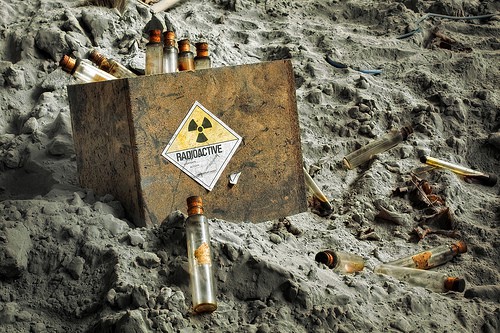
A living cat is placed into a steel chamber along with a hammer, a vial of hydrocyanic acid and a very small
amountof radioactive substance. If even a single "Atom" of the radioactive substance decays during the test
period, a relay mechanism wil trip the hammer, which will in turn, break the vial of poisonous gas and
cause the cat to die.
Nobel prize-winning Austrian physicist Erwin Schrodinger created this mental experiment in 1935 to point :
out the paradox between what quantum theorists held to be true about the nature and behaviour of matter
on the microscopic level and what the average person observes to be true on the macroscopic level with the
unaided eye.
The Copenhagen interpretation of quantum physics, which was the prevailing theory at the time, proposed
exist in multiple states that correspond with different possible outcomes and the possibilities, called
superpositions, do not commit to a definite state until they are observed.
Schrodinger's thought experiment was designed to show what the Copenhagen interpretation would look
like if the mathematical terminology used to explain superposition in the microscopic world was replaced
by macroscopic terms the average person could visualise and understand.
In the experiment, the observer cannot know whether or not an "Atom" of the substance has decayed, and
consequently, does not know whether the vial has broken and the cat has been killed. According to quantum
law under the Copenhagen interpretation, the cat will be both dead and alive until someone looks in the box.
In quantum mechanics lingo, the cat's ability to be both alive and dead until it is observed is referred as
'Quantum indeterminacy" or " the observers paradox." The logic behind the observer's paradox is the proven
ability of observation to influence outcomes.
Schrodinger accepted that superposition exists; during his lifetime, scientists were able to prove its existence
by studying 'interfere' in light waves. Schrodinger wondered, however about when the resolution of possibilities
actually occurs. His thought experiment was intended to motivate people to ask themselves if it was logical for
observation to be the trigger for this experience. Yet wouldn't the cat be either dead or alive, even if not observed?
Throughout the years, Schrödinger's cat analogy has been used to illustrate emerging theories of how quantum
mechanics works. In the 'Many Works' interpretation of quantum law, for example, the cat is both alive and
dead. In this interpretation, the observer and the cat simply exist in two realities--one in which the cat is
dead, and one in which the cat is alive.
http://whatis.techtarget.com/definition ... ingers-cat
interpretation of 'superposition' as it applies to Quantum Theory.
A living cat is placed into a steel chamber along with a hammer, a vial of hydrocyanic acid and a very small
amountof radioactive substance. If even a single "Atom" of the radioactive substance decays during the test
period, a relay mechanism wil trip the hammer, which will in turn, break the vial of poisonous gas and
cause the cat to die.
Nobel prize-winning Austrian physicist Erwin Schrodinger created this mental experiment in 1935 to point :
out the paradox between what quantum theorists held to be true about the nature and behaviour of matter
on the microscopic level and what the average person observes to be true on the macroscopic level with the
unaided eye.
The Copenhagen interpretation of quantum physics, which was the prevailing theory at the time, proposed
exist in multiple states that correspond with different possible outcomes and the possibilities, called
superpositions, do not commit to a definite state until they are observed.
Schrodinger's thought experiment was designed to show what the Copenhagen interpretation would look
like if the mathematical terminology used to explain superposition in the microscopic world was replaced
by macroscopic terms the average person could visualise and understand.
In the experiment, the observer cannot know whether or not an "Atom" of the substance has decayed, and
consequently, does not know whether the vial has broken and the cat has been killed. According to quantum
law under the Copenhagen interpretation, the cat will be both dead and alive until someone looks in the box.
In quantum mechanics lingo, the cat's ability to be both alive and dead until it is observed is referred as
'Quantum indeterminacy" or " the observers paradox." The logic behind the observer's paradox is the proven
ability of observation to influence outcomes.
Schrodinger accepted that superposition exists; during his lifetime, scientists were able to prove its existence
by studying 'interfere' in light waves. Schrodinger wondered, however about when the resolution of possibilities
actually occurs. His thought experiment was intended to motivate people to ask themselves if it was logical for
observation to be the trigger for this experience. Yet wouldn't the cat be either dead or alive, even if not observed?
Throughout the years, Schrödinger's cat analogy has been used to illustrate emerging theories of how quantum
mechanics works. In the 'Many Works' interpretation of quantum law, for example, the cat is both alive and
dead. In this interpretation, the observer and the cat simply exist in two realities--one in which the cat is
dead, and one in which the cat is alive.
http://whatis.techtarget.com/definition ... ingers-cat