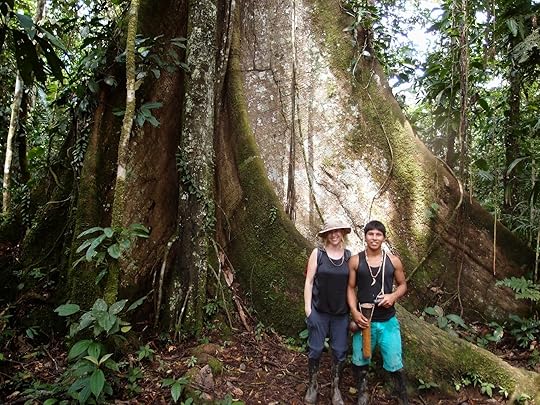
Trees do Talk
Posted: 15 Dec 2017 23:44
Yes trees really do talk.
Take a bracing stroll through a park or wood this weekend and you'll hear the Arctic breeze rippling through the
swaying, leafless branches, almost as if the trees are whispering to each other,
A fanciful thought, perhaps. But make no mistake, trees really do communicate.
They share nutrients, exchange warnings, nurture their young, threaten rivals and bequeath legacies, through an
incredible network of roots and fungal threads that scientists call the 'wood-wide-web'.
Now this mysterious arboreal Internet has acquired a champion in the shape of Dame Judi Dench who this week
revealed herself to be Britain's foremost celebrity nemophilist ( 'one who is fond of woodlands').
In the new BBC TV documentary, the Oscar-winning actress reveals how her passion for trees is such that over 30
years she has allowed her six-acre Surrey garden to return to woodland, where she plants saplings in remembrance of relatives, friends and fellow thespians who have died. These are trees to mark the passing of actors Natasha Richardson, Robert Hardy and Dame Judi's lasted husband, Michael Williams.
While making the programme - Judi Dench, My Passion For Trees - she spent a year working alongside Tony Kirkham, head of the arboretum at the Royal Botanic Gardens Kew, to learn more about the secret world of woodlands.
What she discovered astounded her.
"When I planted trees in memory of my friends, I always hoped they'd be part of a community - that they would be
communicating with each other", she said. It's so reassuring to find out that's true. My trees are part of an extended family".
It was in the nineties that scientists started to realise that trees are not just individuals but active members of a
vigorously chattering, mutually supportive society, not only sharing valuable resources with others of their own
species but forming networks with all comers to ensure their shared survival.
Communicating via that subterranean wood-wide-web - they are wired together by billions of gossamer-fine,
microscopically small tubes called hyphae, like fibre-optic cables that penetrate the earth, weaving through it to
connect a whole woodland or forest.
The hyphae are created by specialised fungi that grow around the trees roots and enable individual trees up to 60ft
apart to network and collaborate with each other, via, chemical and electrical impulses, in dazzling complex ways.
A spoonful of soil can hold up to seven miles of these coiled tubular threads.
Professor Suzanne Simard, an ecologist at the University of British Columbia, has studied these interactions in detail and uses the relationship between a Douglas fir tree and a Birch tree planted next to it to illustrate the mutually beneficial relationship between them.
When the birch was pulled up to give the fir more light, instead of flourishing, the fir started to fail.
Professor Simard established that the trees had developed a support system, using the fungal network to transfer
vital nutrients to each other.
In summer the birch was in full leaf, shading the young fir, it directed food in the form of carbon, nitrogen and water via the hyphae network to the fir.
In spring and autumn, the fir returned the favour when thr birch had no leaves. An awed Professor Simard said 'It might remind you of a sort of intelligence.'
Other studies indicate something still more astounding; trees acting as 'mothers' to saplings that are struggling to grow in the shade beneath high canopies.
The mother thees have been found to feed saplings of all species - yet nepotism is at work in Nature because they
give a little more food to saplings of the same species, and most food to saplings that are close relations.
Without these mother trees, attempts to regenerate forests often fail. When a mother tree is felled, the survival
rate of seedlings tends to be too much reduced.
Trees even seem to leave a sort of 'will'. When one tree is dying, it may pass on resources to neighbours of different species, feeding them and helping to ensure that the forest community stays diverse and strong. In the same way 'sick' trees are supported by the trees around them.
It's mind-blowing, a forest is a special place, every individual is sharing and passing on things to everyone else.
By John Naish for the Daily Mail 08 Dec 2017
Take a bracing stroll through a park or wood this weekend and you'll hear the Arctic breeze rippling through the
swaying, leafless branches, almost as if the trees are whispering to each other,
A fanciful thought, perhaps. But make no mistake, trees really do communicate.
They share nutrients, exchange warnings, nurture their young, threaten rivals and bequeath legacies, through an
incredible network of roots and fungal threads that scientists call the 'wood-wide-web'.
Now this mysterious arboreal Internet has acquired a champion in the shape of Dame Judi Dench who this week
revealed herself to be Britain's foremost celebrity nemophilist ( 'one who is fond of woodlands').
In the new BBC TV documentary, the Oscar-winning actress reveals how her passion for trees is such that over 30
years she has allowed her six-acre Surrey garden to return to woodland, where she plants saplings in remembrance of relatives, friends and fellow thespians who have died. These are trees to mark the passing of actors Natasha Richardson, Robert Hardy and Dame Judi's lasted husband, Michael Williams.
While making the programme - Judi Dench, My Passion For Trees - she spent a year working alongside Tony Kirkham, head of the arboretum at the Royal Botanic Gardens Kew, to learn more about the secret world of woodlands.
What she discovered astounded her.
"When I planted trees in memory of my friends, I always hoped they'd be part of a community - that they would be
communicating with each other", she said. It's so reassuring to find out that's true. My trees are part of an extended family".
It was in the nineties that scientists started to realise that trees are not just individuals but active members of a
vigorously chattering, mutually supportive society, not only sharing valuable resources with others of their own
species but forming networks with all comers to ensure their shared survival.
Communicating via that subterranean wood-wide-web - they are wired together by billions of gossamer-fine,
microscopically small tubes called hyphae, like fibre-optic cables that penetrate the earth, weaving through it to
connect a whole woodland or forest.
The hyphae are created by specialised fungi that grow around the trees roots and enable individual trees up to 60ft
apart to network and collaborate with each other, via, chemical and electrical impulses, in dazzling complex ways.
A spoonful of soil can hold up to seven miles of these coiled tubular threads.
Professor Suzanne Simard, an ecologist at the University of British Columbia, has studied these interactions in detail and uses the relationship between a Douglas fir tree and a Birch tree planted next to it to illustrate the mutually beneficial relationship between them.
When the birch was pulled up to give the fir more light, instead of flourishing, the fir started to fail.
Professor Simard established that the trees had developed a support system, using the fungal network to transfer
vital nutrients to each other.
In summer the birch was in full leaf, shading the young fir, it directed food in the form of carbon, nitrogen and water via the hyphae network to the fir.
In spring and autumn, the fir returned the favour when thr birch had no leaves. An awed Professor Simard said 'It might remind you of a sort of intelligence.'
Other studies indicate something still more astounding; trees acting as 'mothers' to saplings that are struggling to grow in the shade beneath high canopies.
The mother thees have been found to feed saplings of all species - yet nepotism is at work in Nature because they
give a little more food to saplings of the same species, and most food to saplings that are close relations.
Without these mother trees, attempts to regenerate forests often fail. When a mother tree is felled, the survival
rate of seedlings tends to be too much reduced.
Trees even seem to leave a sort of 'will'. When one tree is dying, it may pass on resources to neighbours of different species, feeding them and helping to ensure that the forest community stays diverse and strong. In the same way 'sick' trees are supported by the trees around them.
It's mind-blowing, a forest is a special place, every individual is sharing and passing on things to everyone else.
By John Naish for the Daily Mail 08 Dec 2017