Click 'The Oracle' title above to enter The Oracle Forum and discuss your quest for answers with kindred spirits. Courtesy costs nothing - if you disagree with someone, disagree politely. Abuse is not tolerated.
A powerful birthday present to the all and sundry of Planet Earth from over here to over there, “AMEN THE NAME”, from David Denison 973-eht-namuh-973.com Site Founder, Content Creator and Architect on the occasion of his 86th birthday.
Please follow magic occurrences and reoccurrences of the NUMBER 7 and the fascinating interconnection of creative human sources by clicking on the link below and following the signposts given on this post and consecutive posts beneath it.
Iter placidum fruere Redbeck
Arthur Koestler (born Sept. 5, 1905, Budapest, Hungary — was a Hungarian-born British novelist, journalist, and critic, best known for his novel Darkness at Noon (1940).
ARTHUR KOESTLER
, THOMAS MANN AND SCHOPENHAUERS ESSAY
In the summer of 1937 Arthur Koestler interviewed Thomas Mann for a British newspaper. The meeting was recalled as memorable because of a shared admiration for the "Essay on Death" by Arthur Schopenhauer and Koestler's profile of Thomas Mann.
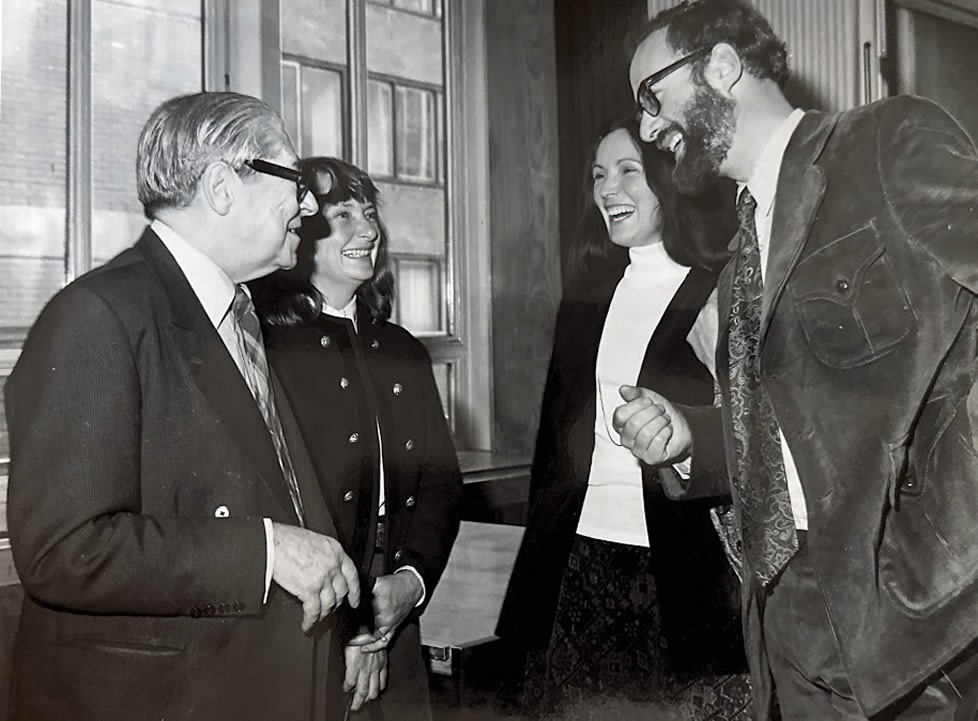
Arthur Koestler wife Cynthia Linda and Dave D at the Koestler Awards October 1977
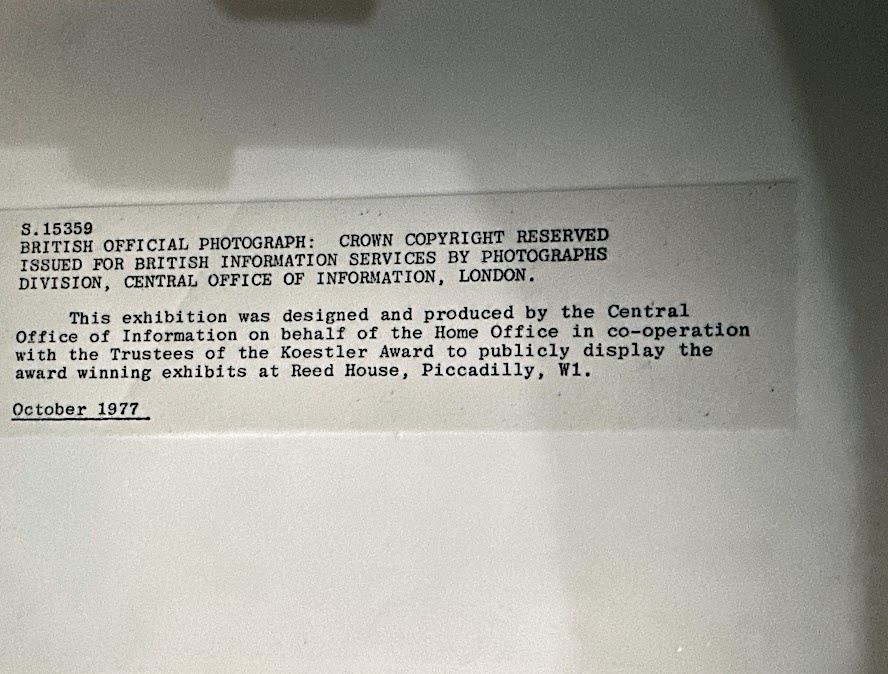
BRITISH OFFICIAL PHOTOGRAPH
david denison artist Koestler Awards from artuk.org
Surrealist artist and teacher, born in Wakefield, Yorkshire, who studied at Doncaster College of Art, 1972. Showed with Camden Arts Centre and widely in north ...
The spectacle of Discipline and Punish: The tableau, the diagram …
Feb 22, 2019 · The award winners are defined as inmates and detainees who are artists rather than artists who also happen to be locked up.
Koestler Silver Award for mixed-media artwork titled "Some prisoners form relationships" ...
Level 1 Open Awards (RQF) Certificate in Skills for Further Learning and Employment. ... - …
Videos of The Koestler Awards "David Denison" Prison Officer Award bing.com › videos
With a new Introduction by Louis Menand
In 1937 during the Spanish Civil War, Arthur Koestler, a German exile writing for a British newspaper, was arrested by Nationalist forces in Málaga. He was then sentenced to execution and spent every day awaiting death—only to be released three months later under pressure from the British government. Out of this experience, Koestler wrote Darkness at Noon, his most acclaimed work in the United States, about a man arrested and executed in a Communist prison. In the summer of 1937 Arthur Koestler interviewed Thomas Mann for a British newspaper. The meeting was recalled as memorable because of a shared admiration for the
Final years, 1976–1983
Early in 1976 Koestler was diagnosed with Parkinson's disease. The trembling of his hand made writing progressively more difficult.[62] He cut back on overseas trips and spent the summer months at a farmhouse in Denston, Suffolk, which he had bought in 1971. That same year saw the publication of The Thirteenth Tribe, which presents his Khazar hypothesis of Ashkenazi ancestry.[63][64][65][66][67][68][69] In 1978, Koestler published Janus: A Summing Up. In 1980 he was diagnosed with chronic lymphocytic leukaemia.[70] His book Bricks to Babel was published that year. His final book, Kaleidoscope, containing essays from Drinkers of Infinity and The Heel of Achilles: Essays 1968–1973, with some later pieces and stories, was published in 1981. During the final years of his life, Koestler, Brian Inglis and Tony Bloomfield established the KIB Society (named from the initials of their surnames) to sponsor research "outside the scientific orthodoxies". After his death it was renamed the Koestler Foundation. In his capacity as vice-president of the Voluntary Euthanasia Society, later renamed Exit, Koestler wrote a pamphlet on suicide, outlining the case both for and against, with a section dealing specifically with how best to do it.[71]
Koestler and Cynthia killed themselves on the evening of 1 March 1983 at their London home, 8 Montpelier Square, with overdoses of the barbiturate Tuinal taken with alcohol.[72] Their bodies were discovered on the morning of 3 March, by which time they had been dead for 36 hours.[73][74] Koestler had stated more than once that he was afraid, not of being dead, but of the process of dying.[75] His suicide was not unexpected among his close friends. Shortly before his suicide his doctor had discovered a swelling in the groin which indicated a metastasis of the cancer.[76][77][78] Koestler's suicide note read:[79]
To whom it may concern.
The purpose of this note is to make it unmistakably clear that I intend to commit suicide by taking an overdose of drugs without the knowledge or aid of any other person. The drugs have been legally obtained and hoarded over a considerable period.
Trying to commit suicide is a gamble the outcome of which will be known to the gambler only if the attempt fails, but not if it succeeds. Should this attempt fail, and I survive it in a physically or mentally impaired state, in which I can no longer control what is done to me, or communicate my wishes, I hereby request that I be allowed to die in my own home and not be resuscitated or kept alive by artificial means. I further request that my wife, or a physician, or any friend present, should invoke habeas corpus against any attempt to remove me forcibly from my house to hospital.
My reasons for deciding to put an end to my life are simple and compelling: Parkinson's disease and the slow-killing variety of leukaemia (CCI). I kept the latter a secret even from intimate friends to save them distress. After a more or less steady physical decline over the last years, the process has now reached an acute state with added complications which make it advisable to seek self-deliverance now, before I become incapable of making the necessary arrangements.
I wish my friends to know that I am leaving their company in a peaceful frame of mind, with some timid hopes for a de-personalised after-life beyond due confines of space, time and matter and beyond the limits of our comprehension. This "oceanic feeling" has often sustained me at difficult moments, and does so now, while I am writing this.
What makes it nevertheless hard to take this final step is the reflection of the pain it is bound to inflict on my surviving friends, above all my wife Cynthia. It is to her that I owe the relative peace and happiness that I enjoyed in the last period of my life – and never before.
Arthur Koestler (1905 - 1983) - Genealogy - Geni.com
Sep 16, 2024 · The note was dated June 1982. Below it appeared the following: Since the above was written in June 1982, my wife decided that after thirty-four years of working together she …
Page 6
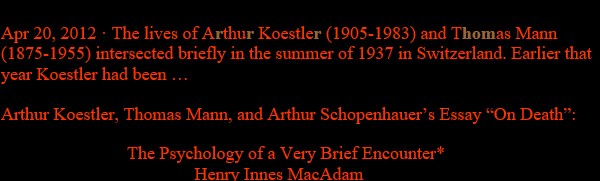
Arthur Koestler, Thomas Mann, and Arthur Schopenhauer’s Essay “On Death”: The Psychology of a Very Brief Encounter* XXXXXXXXXXXXXXXXXXXXXXXXXXXXXX Henry Innes MacAdam
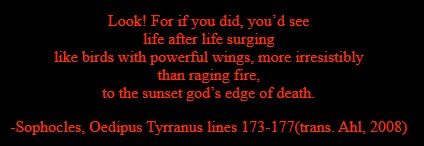
LOOK FOR IF YOU DID
The lives of Arthur Koestler (1905-1983) and Thomas Mann (1875-1955) intersected briefly in the summer of 1937 in Switzerland. Earlier that year Koestler had been released from a Spanish prison where he awaited a death sentence for his known communist party affiliation and his work as a journalist for the British anti-Fascist News Chronicle. It was during that “death row” episode (see Koestler’s first account in his Dialogue with Death, 1937; 1961) that he reflected on the mathematical perfection of Prime Numbers (see on this MacAdam 2009). He also expressed his admiration for the early novels of Thomas Mann, and how much spiritual and intellectual comfort they gave him while imprisoned. Even before returning to London, he wrote to Mann. The most detailed account of this appears in the second volume of Koestler’s autobiography, The Invisible Writing (1954; 1969):
During the first three weeks of solitary confinement, before I was allowed books from the prison library, my only intellectual nourishment had been the remembrance of books read in the past. In the course of these memory exercises, a certain passage from Buddenbrooks came back to me and gave me much spiritual comfort–so much so that at times when I felt particularly dejected, I would have recourse to that scene as it were a pain-soothing pill. The content of the passage, as I remembered it, was this. Consul Thomas Buddenbrook, though only in his late forties, knows that he is about to die. He was never given to any religious or metaphysical speculation, but now he falls under the spell of a book [Arthur Schopenhaurer’s essay On Death, and its Relation to the Indestructibility of our Essential Selves, which appears in Vol. 2 (a supplement to Book 4) of The World as Will and Representation] which for years has stood unread in his library, and in which he finds explained that death is nothing final, merely a transition to another, impersonal form of existence in the All-One… The day after I was set free, I wrote Thomas Mann a letter (I knew that he lived in Zürich-Kuessnacht) in which I explained [my remembrance of Buddenbrooks] and thanked him for the spiritual comfort that I derived from his work. The title of [Schopenhauer’s essay] was expressly mentioned in my letter, which was dated from the Rock Hotel, Gibraltar, May 16 or 17, 1937. Thomas Mann’s answer reached me a few days later in London. It was a handwritten letter which I lost, together with all my files, on my [escape] from France in 1940. I cannot, of course, remember its actual text, only its content which, for the sake of simplicity, I shall paraphrase in direct speech:
Dear Sir: Your letter arrived in May [23rd]. On the afternoon of that day, I was sitting in my garden in Kuessnacht. I had read Schopenhauer’s essay [originally published in 1844 in the second volume of The World as Will] in 1897 or 1898, while I was writing Buddenbrooks, and I had never read it again as I did not want to weaken its original strong impact on me. On that afternoon, however, I felt a sudden impulse to re-read the essay after nearly forty years. I went indoors to my library to fetch the volume. At that moment the postman rang and brought me your letter ... (Koestler, 1969: 452-453). [Yours, etc. Thomas Mann]
Graham Hancock 1996
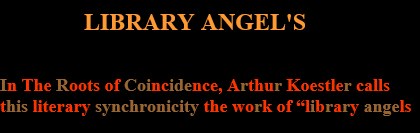
The novelist Arthur Koestler, who had a great interest in synchronicity coined the term "library angel" to describe the unknown agency responsible for the lucky breaks researchers sometimes get which led to exactly the right information being placed in their hands at exactly the right moment".
The Roots of Coincidence is a 1972 book by Arthur Koestler. It is an introduction to theories of parapsychology, including extrasensory perception and psychokinesis. Koestler postulates links between modern physics, their interaction with time and paranormal phenomena. It is influenced by Carl Jung's concept of synchronicity and the seriality of Paul Kammerer
we may represent simultaneous events by the parallel circles of latitude…” That both kinds of connection exist simultaneously, and the self-same event, although a link in two totally different chains, nevertheless falls into place, so that the fate of one individual invariably fits the fate of the other … this is something that surpasses our powers of comprehension, and can only be conceived as possible by virtue of the most wonderful pre-established harmony ... (Koestler, 1973: 107-108–italics mine).
Thus coincidence, for Schopenhauer, is the random “intersection” of persons and/or events on lines of longitude and latitude at a moment in time. With that as the context, and with an earlier reference to Schopenhauer’s influence on Freud and Jung, Koestler then summarizes his own thoughts on coincidence:
The classical theories of ESP proposed by Carington, Tyrrell, Hardy and others were variations on the same theme–a “psychic ether” or group-mind or collective unconscious, serving as a subterranean pool which individual minds can tap, and through which they can communicate. The dominant concept is Unity in Diversity–all is
One and One is all. It echoes through the writings of Christian mystics and is the keynote in Buddhism and Taoism. It provides the parallels of latitude on Schopenhauer’s globe, and ties coincidence in the universal scheme of things. According to Jung, all divinatory practices, from looking at tea leaves to the complicated oracular methods of the I-Ching, are based on the idea that random events are minor mysteries which can be read as pointers towards the one central mystery (Koestler, 1973: 108–on Carl Jung see the Nota Bene below).
At that point, perhaps, Koestler has come full circle: he has combined the randomness of a coincident universe with the randomness of Prime Numbers–a mystery of unexplained perfection.
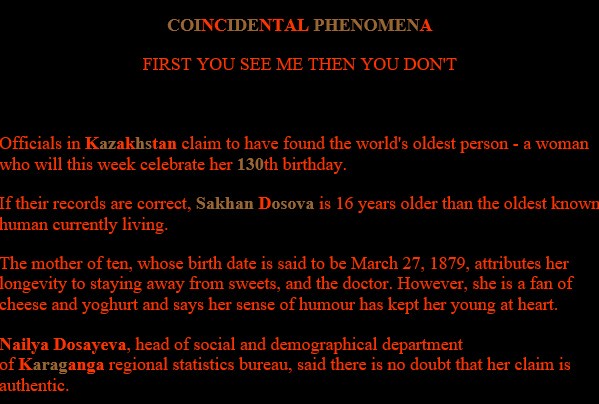
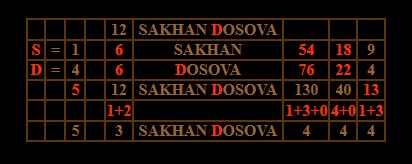
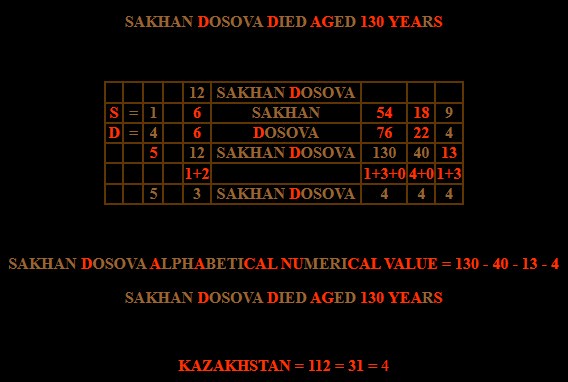
Sakhan Dosova broke her hip in a fall last month and never recovered. She had been given the flat by officials in Kazakhstan who were embarrassed she was living in overcrowded conditions …
She had been given the flat by officials in Kazakhstan who were embarrassed she was living in overcrowded conditions with her impoverished family.
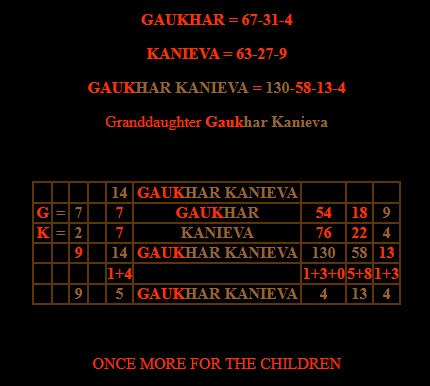
Granddaughter Gaukhar Kanieva, 42, said: "We think laughter and a good mood helped her live so long."
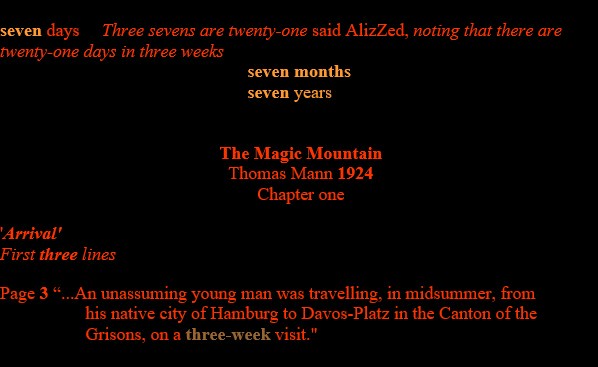
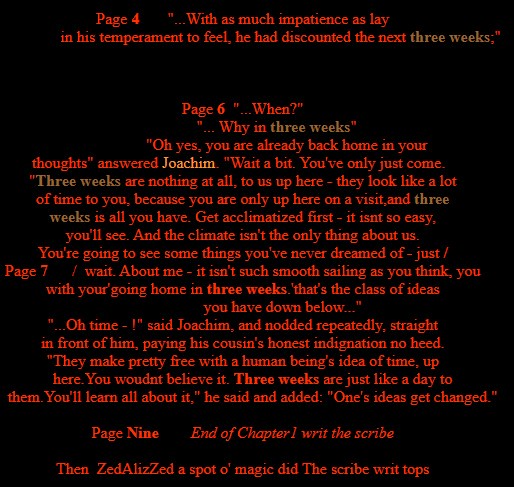
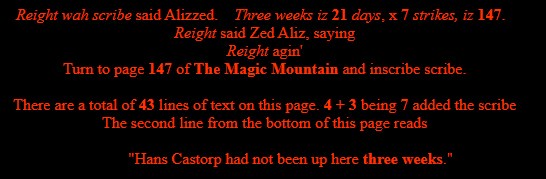
At length, as no one seemed able to settle, Hans Castorp, with his finger on the glass, supporting his cheek on his fist, said he would like to know what was to be / Page 665 / the actual length of his stay up here, instead of the three weeks originally fixed.
Very well since they thought of nothing better, let the spirit out of the fullness of his knowledge answer this chance query. The glass hesitated then pushed off. It spelled out something very queer, which none of them succeeded in fathoming, it made the word, or the syllable Go, and then the word Slanting and then something about Hans Castorp's room. That was to say, through number thirty-four. What was the sense of that"
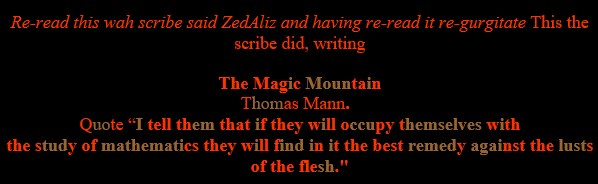
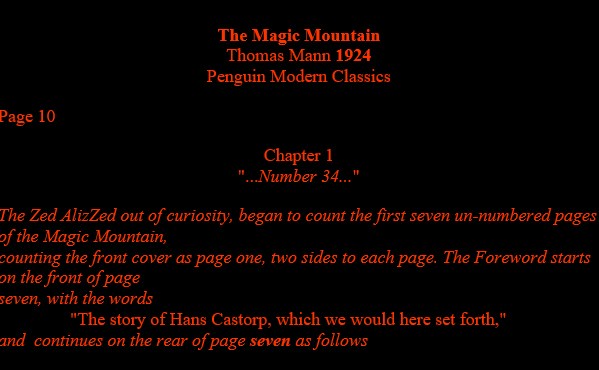
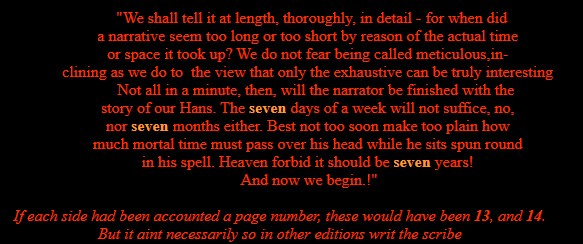
REREAD THIS WAH SCRIBE THOMS MANN MAGIC MOUNTAIN HEADER THOMAS MANN CHAPTER 10 HEADER THOMAS MANN CHAPTER 10 MIDDLE
THE LIVES OF THOMAS MANN AND ARTHUR KOESTLER INTERSECTED 1937
LOOK FOR IF YOU DID
The lives of Arthur Koestler (1905-1983) and Thomas Mann (1875-1955) intersected briefly in the summer of 1937 in Switzerland. Earlier that year Koestler had been released from a Spanish prison where he awaited a death sentence for his known communist party affiliation and his work as a journalist for the British anti-Fascist News Chronicle. It was during that “death row” episode (see Koestler’s first account in his Dialogue with Death, 1937; 1961) that he reflected on the mathematical perfection of Prime Numbers (see on this MacAdam 2009). He also expressed his admiration for the early novels of Thomas Mann, and how much spiritual and intellectual comfort they gave him while imprisoned. Even before returning to London, he wrote to Mann. The most detailed account of this appears in the second volume of Koestler’s autobiography, The Invisible Writing (1954; 1969):
During the first three weeks of solitary confinement, before I was allowed books from the prison library, my only intellectual nourishment had been the remembrance of books read in the past.
During the first three weeks of solitary confinement, before I was allowed books from the prison library, my only intellectual nourishment had been the remembrance of books read in the past. In the course of these memory exercises, a certain passage from Buddenbrooks came back to me and gave me much spiritual comfort–so much so that at times when I felt particularly dejected, I would have recourse to that scene as it were a pain-soothing pill. The content of the passage, as I remembered it, was this. Consul Thomas Buddenbrook, though only in his late forties, knows that he is about to die. He was never given to any religious or metaphysical speculation, but now he falls under the spell of a book [Arthur Schopenhaurer’s essay On Death, and its Relation to the Indestructibility of our Essential Selves, which appears in Vol. 2 (a supplement to Book 4) of The World as Will and Representation] which for years has stood unread in his library, and in which he finds explained that death is nothing final, merely a transition to another, impersonal form of existence in the All-One…
The day after I was set free, I wrote Thomas Mann a letter (I knew that he lived in Zürich-Kuessnacht) in which I explained [my remembrance of Buddenbrooks] and thanked him for the spiritual comfort that I derived from his work. The title of [Schopenhauer’s essay] was expressly mentioned in my letter, which was dated from the Rock Hotel, Gibraltar, May 16 or 17, 1937. Thomas Mann’s answer reached me a few days later in London. It was a handwritten letter which I lost, together with all my files, on my [escape] from France in 1940. I cannot, of course, remember its actual text, only its content which, for the sake of simplicity, I shall paraphrase in direct speech:
Dear Sir: Your letter arrived in May [23rd]. On the afternoon of that day, I was sitting in my garden in Kuessnacht. I had read Schopenhauer’s essay [originally published in 1844 in the second volume of The World as Will] in 1897 or 1898, while I was writing Buddenbrooks, and I had never read it again as I did not want to weaken its original strong impact on me. On that afternoon, however, I felt a sudden impulse to re-read the essay after nearly forty years. I went indoors to my library to fetch the volume. At that moment the postman rang and brought me your letter ... (Koestler, 1969: 452-453). [Yours, etc. Thomas Mann]
Koestler’s letter to Mann, however, does still exist, and it allows us to correct a few dates and to grasp the sense of elation that Koestler felt shortly after his last-minute reprieve from the prison firing squad in Seville. That letter is reproduced in Christian Buckard’s Arthur Koestler: Ein Extremes Leben (2004). Strictu sensu this is not a biography of Koestler, but Buckard devoted three pages (140-143) to the Koestler-Mann episode described above. Koestler’s letter to Mann is in Mann’s archive. Buckard reproduced most of it (Koestler wrote it on 15 May) except (apparently) the greeting and an explicit reference to “On Death” (141-142). Buckard reproduces Mann’s diary entry recording his reception of Koestler’s letter on 23 May 1937 (142). I am grateful to Prof. Michael Scammell of Columbia University for bringing Buckard’s volume to my attention.
Koestler then goes on (in The Invisible Writing) to relate how his interview with Mann later that year (en route to an assignment to the Balkans for the News Chronicle) turned into a social disaster for which Koestler took a large share of the blame: “This was no doubt partly due to my paralysing timidity [there is an amusing reference in this recollection to the socially inept malapropisms of Frau Stöhr in The Magic Mountain] and gaucherie in the master’s presence; on the other hand Mann did nothing to put me at ease” (Koestler, 1969: 453-454). That allusion to Mann’s uneasiness regarding the media (even, in Koestler’s case, a German-speaking journalist) is hardly unique. In later years Mann was on several occasions impelled to write letters to the editors of journals (particularly the USA based Time magazine) to “explain” or “correct” certain statements he had made in the course of interviews. It may be instructive to note the parallel career of Mann’s cultural if not spiritual near-contemporary, German composer Walter Braunfels (1882-1950)–see a report on the revival of his 1920 opera Die Vögel (based on Aristophanes’ still relevant satiric comedy The Birds) in Tomassini (2009).
What is worth noting here is Koestler’s ambivalent appraisal of Mann, someone he admired for the early novels (especially Buddenbrooks, noted above) and non-fiction but found fault with for his seemingly waffling attitude to German political developments before and after 1933, as well as his (Mann’s) later literary output during his prolonged political and cultural exile. This is nearly if not exactly the critique made of Koestler’s own oeuvre during his peregrinations (initially prompted by WW II) to the U.K., to Israel, to the U.S.A, to France, and eventually and permanently back to the UK (on that diaspora theme see Cesarani, 1998). Since Mann was still alive when this volume of Koestler’s autobiography was published [1954] it may be worth reproducing excerpts from his assessment of Mann’s influence on German (and European) literature of the 20th century. I do not know if Mann might have read this critique of his own career before his death in 1955, and none of the biographies of Mann which I’ve consulted offer any insight:
Since that unhappy meeting, [i.e. between 1937- c.1953] I have re-read a substantial part of Thomas Mann’s early work. Much of it has lost its original impact on me, but it has retained its grandeur and subtlety, its poetic irony, its universal sweep and range. Most of his later work I find mannered to the point where it becomes unreadable. But Buddenbrooks and The Magic Mountain, the stories and essays (excluding the political essays), and indeed the major part of his work up to and including the last volume of Joseph [published in 1943; the fourth volume of a tetralogy] remain as a monument of the early twentieth century, and Germany’s most important single contribution to its [twentieth century?] culture. Thus, personal disappointment did not diminish my admiration and gratitude for Mann’s work.
There has perhaps never been a great novelist so completely lacking the Dostoievskian touch of sympathy for the poor and humble. In Mann’s universe, charity is replaced by irony, which is sometimes charitable, sometimes not; his attitude to his characters, even at its most sympathetic, has a mark of Olympian condescension …
The only exception to this is Mann’s treatment of children and dogs; perhaps because here condescension, the gesture of bending down, is implicit in the situation. The title of his only story about dogs is, revealingly: Herr und Hund. which does not prevent it, however, from being a masterpiece (Koestler, 1954, republished 1969: 455-456).Koestler then moves on to criticism of Mann in political/ideological terms, an assessment not always noted by Mann biographers who didn’t live through the convoluted era of c. 1930-l945 or who do not see Koestler from the perspective of a committed communist who eventually lost faith and promoted leftist violence as the correct response to fascism (on this see Bance, 2002: 116). It is worth noting that Mann himself expressed such sentiments, although in a very muted way. In his diary entry for 2 March 1954 Mann wrote that he hoped someone would assassinate U.S. Senator Joseph McCarthy and end the anti-communist witch hunt (which included an FBI file on Mann after he visited East Germany on several occasions) begun by that demagogue in 1949 (Reed, 2002:15).
Koestler’s summary of Mann’s literary influence concludes with these thoughts: The result [of Mann’s philosophy through his publications] is a humanism without the cement of affection for the individual human brick, a grandiose, but unsound edifice which was never proof against the nasty gales and currents of the times. This may explain a series of episodes in Mann’s public career which were exploited by his opponents and embarrassed his admirers–such as his support of Prussian imperialism in the first World War; his hesitant and belated break with the Nazis; his silent endorsement of the new despotism in Eastern Germany [after 1949], and his acceptance of the Goethe Prize [also in 1949] from a régime which banned and burned the books of his compatriots and fellow-authors …
… They do not affect Mann’s greatness as an artist, but they have defeated his claim to the cultural leadership of the German nation. It is impossible to be angry with Picasso for believing that Stalin was the greatest benefactor of mankind, for one feels that his error is the result of a naïve and warmhearted passion. But it is not so easy to forgive the moral faux pas of the ironically dispassionate Olympian (Koestler, 1969: 456).
There is a distinct psychological dimension to the brief encounter of Koestler and Mann. It may be due in part to the fact that Schopenhauer’s nearly two-century long reputation rests as much on his psychological insights as it does on his philosophical or spiritual convictions. Puzzling to me is Koestler’s lack of comment on Mann’s extraordinary novel Death in Venice (1912) and its haunting depiction of the acceptance of death as a consequence of obsessional desire. In the classical world the Greek concept of Tychê and the Roman concept of Fatum (loosely translated as “Luck” and “Destiny” respectively) were compared and contrasted (especially by the Stoics) to determine, if possible, which played a greater role in human affairs.
Perhaps the best illustration of that disturbing, dramatic, psychological tension is the very different treatment of the “two faces” of Oedipus Tyrannus/Rex in Greek (Sophocles) and Roman (Seneca) stage tragedy–on this see most recently Ahl (2008). Koestler and Mann also appreciated that same dynamic “fate” and/or “fortune” tension in the human psyche, but for them expressed more directly by Schopenhauer than by Sophocles. It is to Koestler’s credit that he could subject Mann to equal portions of criticism and praise. Certainly, he appreciated, as did Mann, the role of coincidence not just in general, but as an active aspect of how they met each other.
SO READ ME ONCE AND READ ME TWICE AND READ ME ONCE AGAIN IT’S BEEN A LONG, LONG TIME[/color]
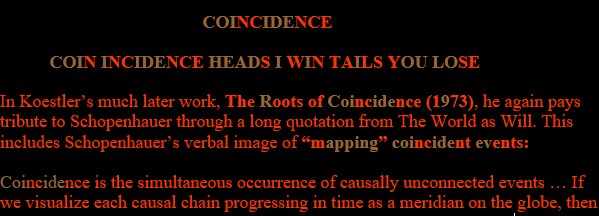
In Koestler’s much later work, The Roots of Coincidence (1973), he again pays tribute to Schopenhauer through a long quotation from The World as Will. This includes Schopenhauer’s verbal image of “mapping” coincident events:
Coincidence is the simultaneous occurrence of causally unconnected events … If we visualize each causal chain progressing in time as a meridian on the globe, then we may represent simultaneous events by the parallel circles of latitude…” That both kinds of connection exist simultaneously, and the self-same event, although a link in two totally different chains, nevertheless falls into place, so that the fate of one individual invariably fits the fate of the other … this is something that surpasses our powers of comprehension, and can only be conceived as possible by virtue of the most wonderful pre-established harmony ... (Koestler, 1973: 107-108–italics mine).
Thus coincidence, for Schopenhauer, is the random “intersection” of persons and/or events on lines of longitude and latitude at a moment in time. With that as the context, and with an earlier reference to Schopenhauer’s influence on Freud and Jung, Koestler then summarizes his own thoughts on coincidence:
The classical theories of ESP proposed by Carington, Tyrrell, Hardy and others were variations on the same theme–a “psychic ether” or group-mind or collective unconscious, serving as a subterranean pool which individual minds can tap, and through which they can communicate. The dominant concept is Unity in Diversity–all is One and One is all. It echoes through the writings of Christian mystics and is the keynote in Buddhism and Taoism. It provides the parallels of latitude on Schopenhauer’s globe, and ties coincidence in the universal scheme of things. According to Jung, all divinatory practices, from looking at tea leaves to the complicated oracular methods of the I-Ching, are based on the idea that random events are minor mysteries which can be read as pointers towards the one central mystery (Koestler, 1973: 108–on Carl Jung see the Nota Bene below).
At that point, perhaps, Koestler has come full circle: he has combined the randomness of a coincident universe with the randomness of Prime Numbers–a mystery of unexplained perfection.
Additional Notes:
While this article was in press Michael Scammell’s definitive biography Koestler: The Literary and Political Odyssey of a Twentieth-Century Skeptic was published in December 2009 by Random House in the USA and by Faber & Faber in the UK. In it he not only refers to the Koestler-Mann interview in the summer of 1937 but translates most of the text of Koestler’s letter to Mann that Buckard (2004: 141-142) reproduced from among Mann’s archived correspondence. At the end of it Koestler summarized his reasons for writing to Mann at such a critical point in his (Koestler’s) career:
Ich glaube, ich habe es Ihnen zu danken dass ich noch am Leben bin; zumindest, dass ich noch bei Verstand bin … Ich hätte es früher niemals für möglich gehalten, dass Kunst eine derartigen, drastischen Einfluss auf das Leben gewinnen kann (Buckard, 2004: 141).
To put it baldly, I believe I have you to thank for the fact that I’m still alive, or, at least, that I still have my wits about me … I would never have thought it possible that art could exercise such a drastic influence on my life (Scammell, 2009: 142).
As a coda I might add that Mann’s letter to Koestler may still exist. Many of Koestler’s typescript books and private papers were taken from his Paris apartment during raids by the anti-communist French police, the Deuxième Bureau, between the outbreak of WW II in September 1939 and the Nazi occupation of France the following spring. Koestler always believed that these losses were irretrievable. But in e-mail correspondence with Michael Scammell, I learned that he saw some of this material in what had been the former KGB archives in Moscow during a visit there in 1994.The Nazis took to Berlin what they seized in Paris, and in turn the Soviets took the Nazi archives to Moscow after they occupied Berlin in the spring of 1945.
Scammell was particularly eager to discover if the German original typescript of Darkness at Noon (translation by Daphne Hardy, published in 1941) was among Koestler’s effects, but found instead three original German typescripts of The Gladiators (translation by Edith Simon, published in 1939). Not realizing that all other copies of the German original of The Gladiators had either been lost or discarded, Scammell did not try to obtain a microfilm or photocopy. He did note that Koestler’s working title for the novel had been Der Sklavenkrieg (The Slave War–see Scammell, 2009: 164 and note #1) not, as I and others had assumed, Die Gladiatoren (see Burkard, 2004: 162). Scammell failed to find a copy of the German original of Darkness at Noon; a portion of which Koestler somehow recovered in the U.K. after WW II.
Mann’s handwritten letter in reply to Koestler’s lengthy and philosophical missive of May 1937 may be within the Koestler files in Moscow or in Paris if those files were repatriated to France since the fall of the Soviet Empire. Certainly, Mann did not make a copy of it before posting the original to Koestler or it would be among the extensive correspondence collection in the Thomas Mann archive. I have tried to make contact with the Directorate of the Russian Federation State Military Archive regarding Koestler’s typescripts and personal papers, but so far to no avail.
Prof. Scammell shared the above information with me via e-mails between late 2008 and mid-2009 (see Scammell, 1998 esp. p. 28 for his visit to the Moscow KGB and Comintern archives where he discovered a copy each of Koestler’s two letters of resignation from the German Communist Party).The irony is that after WW II both novels were back-translated into German, The Gladiators from the translation done by Edith Simon, and Darkness at Noon from the translation done by Daphne Hardy (who had fled from German-occupied Paris with Koestler in early 1940).
My thanks to Prof. Scammell for his gracious assistance in this and several other matters during the preparation of this article. Grateful thanks also to Brent Shaw of Princeton University for making Buckard’s volume available and for patiently allowing me to expound on the subject of this essay in person over several lunches, and via e-mail correspondence.