Helen Duncan was convicted under the Witchcraft Act of 1735 during WWII.
By Qin Xie For Mailonline
Helen Duncan was sentenced to 9 months in jail for witchcraft in 1944 after having a premonition about
the Royal Navy HMS Barham before the news was announced to the public.
However, campaigners for her pardon now hope that, with the introduction of "Turing's Law". Duncan can
be exonerated after legislation that was used to convict her was similarly repeated.
Duncan, from Callander in Stirlingshire, was a housewife and mother to 6 children.
She was said to have been well-known in spiritualist circles for her apparent ability to communicate with
the dead.
In 1941, she held a seance in Portsmouth where she claimed to have made contact with a sailor who had
died aboard HMS Barham.
The Royal Navy vessel had been torpedoed in the Mediterranean, with 800 lives lost, but the news had not
been made public.
Duncan's vision was therefore considered a threat to national security and, supposedly could even have
jeapardised the outcome of the war according to some military chiefs.
She was arrested,branded a traitor and ended up being one of the last people to be charged under the
Witchcraft Act of 1735 and was sentenced to 9 months in jail.
Duncan, often dubbed Britain's last witch, died in 1956 while the Witchcraft Act of 1735 was repealed
in 1951.
Jane Rebecca Yorke was another medium who was targeted as a witch was tried after the war and after
the time of Helen Duncan, therefore she was the very last to be convicted under the Witchcraft Law of
1735.
https://www.google.co.uk/amp/www.dailym ... -ship.html
Britain's Last Witch?
Last edited by hope on 04 Sep 2017 14:05, edited 2 times in total.
Re: Btitain's Last Witch?
HMS Barham
Last edited by hope on 04 Sep 2017 14:06, edited 1 time in total.
-
Redbeck
- Site Admin
- Posts: 2147
- Joined: 19 Dec 2010 15:42
- Location: The Rookery, 3rd Horse Chestnut along, St Johns, Britain. Teacher leave our nuts alone!
- Contact:
Re: Britain's Last Witch?
Fascinating post Hope, what an excavation thank you, some extra facts on the mysterious Helen Duncan:
Born in Callander in 1897, Callander is a small town in the council area of Stirling, Scotland, located on the River Teith in the historic county of Perthshire. The daughter of a cabinet-maker, Helen Duncan was a show woman who travelled throughout Britain, holding regular séances during which she would produce the form of dead people by emitting a cloud-like substance – ectoplasm – from her mouth. These spirits were said to appear, talking and actually touching their relatives.
A large woman, she weighed over 22 stone (that is over 300 pounds in USA parlance).
On the night of 19 January 1944, one of Helen’s séances was raided by police, in her then hometown of Portsmouth. Officers attempted to stop the ectoplasm issuing from Helen’s mouth, but failed. After some degree of order had been restored, Helen was formally arrested.
Imprisoned for 9 months in 1944 under the Witchcraft Act of 1753, her case finally led to the repeal of the Act in 1951. A formal Act of the British Parliament three years later officially recognised spiritualism as a religion.
Yet old superstitions still run high. A bronze bust of Helen Duncan, presented to the town of Callander, is the subject of controversy even today, as those with strong religious views object to its public display. As a consequence the sculpture is currently on display at the Stirling Smith Art Gallery and Museum.
The last person to be executed in Britain for witchcraft was Janet Horne in 1727, who also happened to be from Scotland. Neighbours in Dornoch, Sutherland, accused her of using her daughter as a pony to ride to see the Devil and she was burned at the stake.


Helen Duncan, pictured with her husband Henry, after the war

Born in Callander in 1897, Callander is a small town in the council area of Stirling, Scotland, located on the River Teith in the historic county of Perthshire. The daughter of a cabinet-maker, Helen Duncan was a show woman who travelled throughout Britain, holding regular séances during which she would produce the form of dead people by emitting a cloud-like substance – ectoplasm – from her mouth. These spirits were said to appear, talking and actually touching their relatives.
A large woman, she weighed over 22 stone (that is over 300 pounds in USA parlance).
On the night of 19 January 1944, one of Helen’s séances was raided by police, in her then hometown of Portsmouth. Officers attempted to stop the ectoplasm issuing from Helen’s mouth, but failed. After some degree of order had been restored, Helen was formally arrested.
Imprisoned for 9 months in 1944 under the Witchcraft Act of 1753, her case finally led to the repeal of the Act in 1951. A formal Act of the British Parliament three years later officially recognised spiritualism as a religion.
Yet old superstitions still run high. A bronze bust of Helen Duncan, presented to the town of Callander, is the subject of controversy even today, as those with strong religious views object to its public display. As a consequence the sculpture is currently on display at the Stirling Smith Art Gallery and Museum.
The last person to be executed in Britain for witchcraft was Janet Horne in 1727, who also happened to be from Scotland. Neighbours in Dornoch, Sutherland, accused her of using her daughter as a pony to ride to see the Devil and she was burned at the stake.


Helen Duncan, pictured with her husband Henry, after the war

Re: Britain's Last Witch?
Thank you Redbeck for the extra information.
The Water Torture
Dunking is a form of punishment that was mainly reserved for supposed witches, the victim was tied to
a chair which was elevated or lowered by the torturer, if he noticed that the victim was going to pass out,
he elevated the chair.
When he needed informant the victim was willing to cooperate, he lowered the chair. This method was
widely used during the Spanish Inquisition and in England and France. The victim was usually intermittently
submerged for many hours until he or she revealed information or death occurred.
While witches were commonly tortured using this method, thieves and murderers could be subject to it in
order to extract a confession. This was more common when other more sophisticated torture devices were
not present.
The ducking stool was used not only for witches but to punish women who were 'scolds', women who spoke
their minds and disagreed with their husbands.
These women were not obeying the oath they took when they married, of honouring and obeying their
husbands.
The Water Torture
Dunking is a form of punishment that was mainly reserved for supposed witches, the victim was tied to
a chair which was elevated or lowered by the torturer, if he noticed that the victim was going to pass out,
he elevated the chair.
When he needed informant the victim was willing to cooperate, he lowered the chair. This method was
widely used during the Spanish Inquisition and in England and France. The victim was usually intermittently
submerged for many hours until he or she revealed information or death occurred.
While witches were commonly tortured using this method, thieves and murderers could be subject to it in
order to extract a confession. This was more common when other more sophisticated torture devices were
not present.
The ducking stool was used not only for witches but to punish women who were 'scolds', women who spoke
their minds and disagreed with their husbands.
These women were not obeying the oath they took when they married, of honouring and obeying their
husbands.
Last edited by hope on 04 Sep 2017 14:07, edited 1 time in total.
-
Redbeck
- Site Admin
- Posts: 2147
- Joined: 19 Dec 2010 15:42
- Location: The Rookery, 3rd Horse Chestnut along, St Johns, Britain. Teacher leave our nuts alone!
- Contact:
Re: Britain's Last Witch?
The History and Topography of the Parish of Wakefield and its Environs by John Hewitt Vol 1 1862
Being a "scold" was apparently a highly undesirable trait. There are relatively frequent entries in the area court records of women being punished for being a "scold".
Hewitt writes,
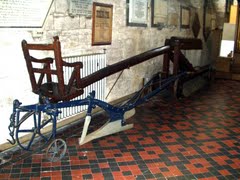
"The ancient Dunking Stool, that most singular contrivance of our forefathers, for the punishment of Female Scolds, consisted of a chair or stool, in or on which the angry lady was tightly strapped: and this chair being securely fastened with an iron or wooden-pin to one end of a long pole. She was in that position (the pole being hoisted perpendicularly) carried aloft at a considerable altitude above the heads of her tormentors, to the nearest shore of the Calder: and, when arrived there, the pole was placed horizontally across a large trestle standing alongside the river, and thus suspended to her great chagrin, she was swinging to and fro in mid-air over the water, and the next moment, by means of the people's moving this pole upwards and downwards, in th manner of what is called in Wakefield, "A ranty-pole," the Dunking Stool was consequently also moved downwards and upwards and the "Scolding woman was repeatedly immersed overheat in the water, in order to cool down her hot temperament: after which, when the operators thought she had had a sufficient number of plunges, they liberated her form the stool, and thus, whilst in a most pitiful plight- dripping wet- ashamed, and undoubtedly, humbled, she became th laughing stock of the spectators, as well as a suitable, but rather unenviable subject of butts, scorns, and sneers of her facetious neighbors, whose merriment on the occasion seemed almost unbounded."
"Previous to the Scolds being immersed in the river, they were, whilst fastened in the "Stool," paraded on men's shoulders through the principal parts of the town"
'The Ducking Stool of Wakefield was the property of the town, and regularly kept in repair at the expense of the rate-payers. Long after is disuse it was kept in existence and carefully repaired several times in the reigns of George II and George III."
Leeds Nostalgia - Yorkshire Post
Ducking Stool: this implement was used to punish 'gossiping women and dishonest alewives'. It was used mainly in the 15th century and was still in use in the 18th. The Leeds one stood at Quarry Hill.

Being a "scold" was apparently a highly undesirable trait. There are relatively frequent entries in the area court records of women being punished for being a "scold".
Hewitt writes,
"The ancient Dunking Stool, that most singular contrivance of our forefathers, for the punishment of Female Scolds, consisted of a chair or stool, in or on which the angry lady was tightly strapped: and this chair being securely fastened with an iron or wooden-pin to one end of a long pole. She was in that position (the pole being hoisted perpendicularly) carried aloft at a considerable altitude above the heads of her tormentors, to the nearest shore of the Calder: and, when arrived there, the pole was placed horizontally across a large trestle standing alongside the river, and thus suspended to her great chagrin, she was swinging to and fro in mid-air over the water, and the next moment, by means of the people's moving this pole upwards and downwards, in th manner of what is called in Wakefield, "A ranty-pole," the Dunking Stool was consequently also moved downwards and upwards and the "Scolding woman was repeatedly immersed overheat in the water, in order to cool down her hot temperament: after which, when the operators thought she had had a sufficient number of plunges, they liberated her form the stool, and thus, whilst in a most pitiful plight- dripping wet- ashamed, and undoubtedly, humbled, she became th laughing stock of the spectators, as well as a suitable, but rather unenviable subject of butts, scorns, and sneers of her facetious neighbors, whose merriment on the occasion seemed almost unbounded."
"Previous to the Scolds being immersed in the river, they were, whilst fastened in the "Stool," paraded on men's shoulders through the principal parts of the town"
'The Ducking Stool of Wakefield was the property of the town, and regularly kept in repair at the expense of the rate-payers. Long after is disuse it was kept in existence and carefully repaired several times in the reigns of George II and George III."
Leeds Nostalgia - Yorkshire Post
Ducking Stool: this implement was used to punish 'gossiping women and dishonest alewives'. It was used mainly in the 15th century and was still in use in the 18th. The Leeds one stood at Quarry Hill.

-
ANONYMOUS1999
- Posts: 122
- Joined: 21 Apr 2017 01:36
- Contact:
Re: Britain's Last Witch?
https://www.youtube.com/watch?v=O7ONp-GC7vM 77
78
87
77
LL
"The lord is my shepherd i shall not want." Oh my tetragrammaton!
"There would be no passion in the world if we never had to fight for what we love."
78
87
77
LL
"The lord is my shepherd i shall not want." Oh my tetragrammaton!
"There would be no passion in the world if we never had to fight for what we love."
Who is online
Users browsing this forum: Bing [Bot] and 5 guests